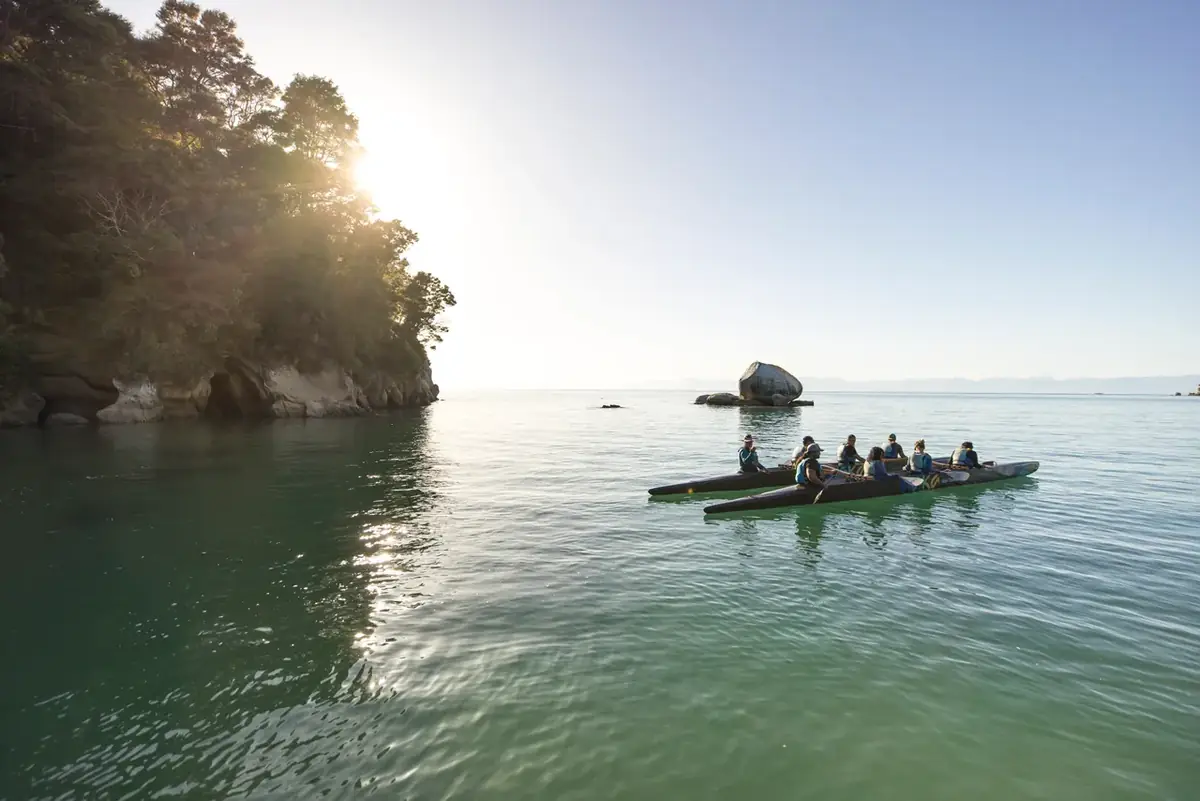
Abel Tasman National Park covers 237 km² at the top of the South Island, between Tasman Bay and Golden Bay. It is the smallest of New Zealand's national parks, and one of the busiest, because what it has is easy to love: a granite coast of little bays with golden sand, clear green water, bush down to the high tide line and a gentle walking track joining them all. There is no road along the coast. You go in on foot, by kayak or by water taxi from Mārahau or Kaiteriteri, about an hour's drive from Nelson.
Of the itineraries we sell, 21 include Abel Tasman, and 21 of them stay at Mārahau, the road end at the southern gate of the park, 21 of them for two nights. They are self drive trips, and they sleep at Ocean View Chalets, above the beach at Mārahau. The day in between is spent in the park itself: most often a boat up the coast and a walk back. 8 of them book the seals, beach cruise and walk day, and 4 take the open day pass that lets you choose your own beach.
- From Nelson (to Mārahau)
- 67 km, about 1 h
- From Blenheim (to Mārahau)
- 178 km, about 2 h 30
- From Picton (to Mārahau)
- 175 km, about 2 h 30
- Nearest airport
- Nelson (NSN), about 1 h by road to Mārahau
Where it is, and who it is named after
The park runs up the coast from Mārahau in the south to Wainui, on the Golden Bay side, with forested hills rising straight behind the beaches. Motueka, about 20 km south of Mārahau, is the nearest town with supermarkets and fuel; Nelson, 67 km away on a sealed road, is the nearest city and airport. The water is at its most striking over the sand: the granite breaks down into coarse golden quartz, and on a sunny day the bays turn a green you would expect much further north.
It was made a national park in 1942, on the 300th anniversary of the Dutch navigator Abel Tasman reaching New Zealand in 1642. Tasman never landed. His ships anchored in Golden Bay, then home to Ngāti Tūmatakōkiri, and a clash with a waka that left four of his crew dead sent him away; he named it Murderers Bay. In 2016 New Zealanders crowdfunded the purchase of a 7 hectare private beach at Awaroa and gave it to the park, which tells you something about how people here feel about the place.
Things to do in Abel Tasman National Park
- Water taxi and walk: the classic day. A boat drops you at one of the bays up the coast (Anchorage, Bark Bay, Onetahuti, Awaroa or Tōtaranui) and you walk back towards Mārahau, or to a later pick-up point. You choose the length. Book ahead in summer; the boats fill.
- Sea kayaking: guided trips paddle along the southern half of the park, around the islands and into the lagoons, with fur seals on the rocks of the Tonga Island Marine Reserve further north. Freedom hire is available for experienced pairs; solo kayak hire is generally not.
- A cruise: for anyone who does not want to walk far, the scheduled boats run the coast and let you off at a beach for a few hours. Most pass Split Apple Rock, a granite boulder split cleanly in two near Kaiteriteri.
- The Coast Track: one of the New Zealand Great Walks, about 60 km from Mārahau to Wainui over three to five days, on a wide, well-graded track with the gentlest gradients of any of them. You can do any stretch of it as a day walk.
- Swimming and doing nothing: this is allowed. The beaches at Anchorage, Te Pukatea Bay and Apple Tree Bay are among the best in the country for an afternoon.
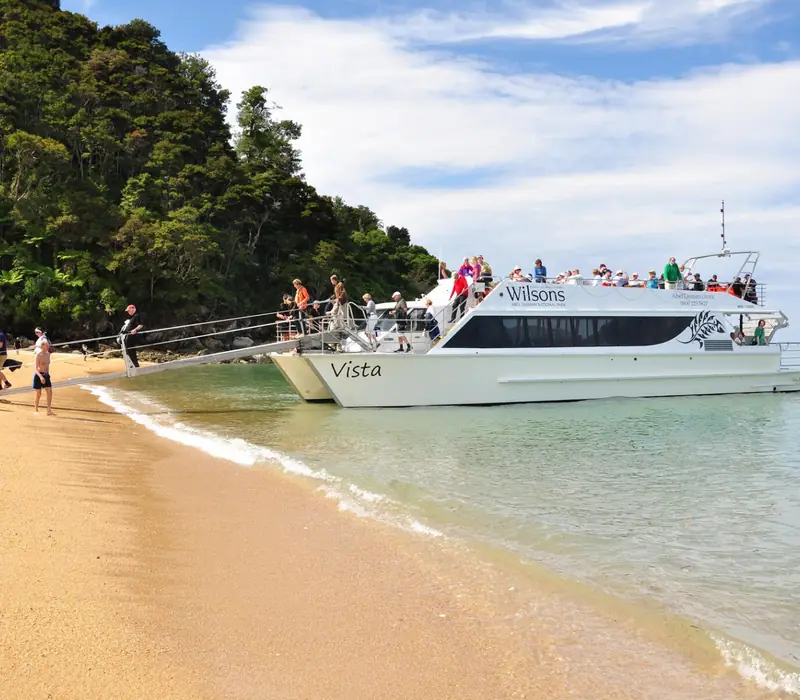
Our Abel Tasman guide goes through the water taxi combinations in detail, and the Great Walks guide puts the Coast Track beside the others.
Tides: the thing that catches people out
The tidal range here is large, up to about 6 m in places, and it changes the park twice a day. At low tide the estuaries drain to sand flats you can walk across; at high tide they are water. On the Coast Track, the Awaroa Inlet crossing can only be made from an hour and a half before low tide to two hours after, and there is no way round. Torrent Bay can be crossed two hours either side of low tide, with a longer all-tide track if you miss it. Water taxi pick-ups at some beaches depend on the tide too.
How to get to Abel Tasman National Park
Nearly everyone comes in from the south, through Motueka to Mārahau or Kaiteriteri, where the water taxis and kayak companies are based. The northern end is reached over Tākaka Hill into Golden Bay and out along a partly unsealed road to Tōtaranui or Wainui: worth it if you are staying in Golden Bay, a long way round if you are not. No road links the two ends inside the park.
| From | Distance | Driving time | How our tours do it |
|---|---|---|---|
| Nelson to Mārahau | 67 km | About 1 h | The nearest airport; 1 itineraries arrive this way |
| Blenheim to Mārahau | 178 km | About 2 h 30 | The usual approach, from 10 itineraries |
| Picton (Interislander ferry) to Mārahau | About 175 km | About 2 h 30 | For trips that cross Cook Strait the same day |
| Mārahau to Westport | About 240 km | About 3 h 30 | Down the Buller Gorge to the West Coast, on 5 itineraries |
How many days you need, and can you do it in one?
One full day inside the park is enough to understand it: a water taxi up the coast, a walk of three or four hours back through two or three bays, a swim, and a boat home. That is what our itineraries do, with two nights at Mārahau so the day in the park is a whole day and not squeezed between drives. A day trip from Nelson works too, but you give up an hour each way on the road and lose the evening light on the beach.
Two days in the park lets you kayak one day and walk the next, which is the combination we would pick. The full Coast Track takes three to five days and needs the huts or campsites booked in advance at any time of year; high season hut fees for international visitors are NZ$84 a night per adult, set by DOC. Four days is the comfortable pace if you walk all of it.
Where to stay: Mārahau, Kaiteriteri, or inside the park
Mārahau is a small settlement at the park entrance: the water taxi base, a couple of cafes, holiday parks and chalets, and the start of the track at the end of the road. It is where our itineraries stay, at Ocean View Chalets (21 of them), for the simple reason that you can walk from your room to the boats. Kaiteriteri, a few minutes away by road, has the bigger beach and more holiday houses. Motueka has the most beds and the supermarket; Nelson is an hour out and suits a day trip.
You can also stay inside the park. DOC runs four huts and 18 campsites along the Coast Track, all booked in advance year round, and there is a private lodge at Awaroa reached by boat or on foot. A handful of baches and lodges at Torrent Bay can be reached only by water. For more on the region around the park, see Nelson and Marlborough.
Weather, and when to go
This is the sunniest corner of the country. Nelson records over 2,400 hours of sunshine a year and under 1,000 mm of rain, spread evenly through the seasons, with summer highs of 22 to 23°C. December to March is the best time for swimming and kayaking, and the busiest; the water taxis and campsites fill in the New Zealand school holidays from Christmas to the end of January. February and March are our pick: warm water, settled weather and the families gone. Winter is quiet and often clear, with calmer water and fewer insects, but it is cold on the water and days are short. The boats run all year.
What the itineraries do in Abel Tasman National Park
21 of our itineraries reach Abel Tasman National Park and 21 sleep there: 21 for 2 nights. Counted from the day by day of every tour, so the numbers move with the catalogue.
- Abel Tasman National Park on 17 itineraries
- Seals, Beach Cruise and Walk on 8 itineraries
- Abel Tasman National Park Cruise and Walk Open Day Pass on 4 itineraries
- Interislander Ferry Wellington to Picton on 4 itineraries
- Ocean’s Cabin with Whale Watch Kaikōura on 2 itineraries
- 30 Minute Whale Watch Explorer with Wings over Whales Kaikoura on 1 itinerary
- Captains Cabin Experience with Whale Watch Kaikoura on 1 itinerary
- Marlborough Icons Tour with Marlborough Tour Company - Lunch Included on 1 itinerary
Where they stay: Ocean View Chalets (21). Every property is named on its tour page, with the room grade.
Most arrive from Blenheim (10), Kaikōura (6), Wellington (4) and carry on to Wellington (7), Westport (5), Kaikōura (4).