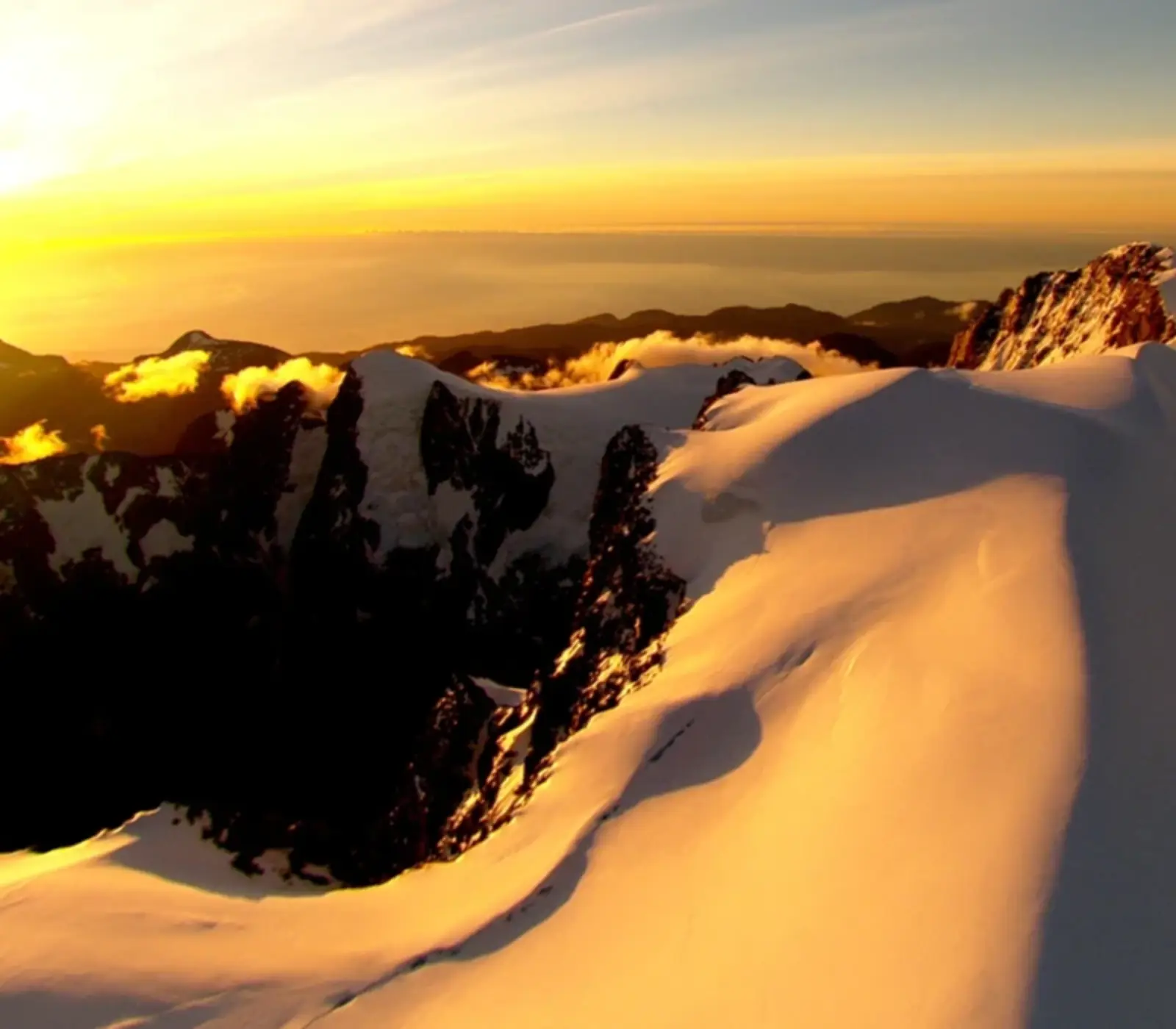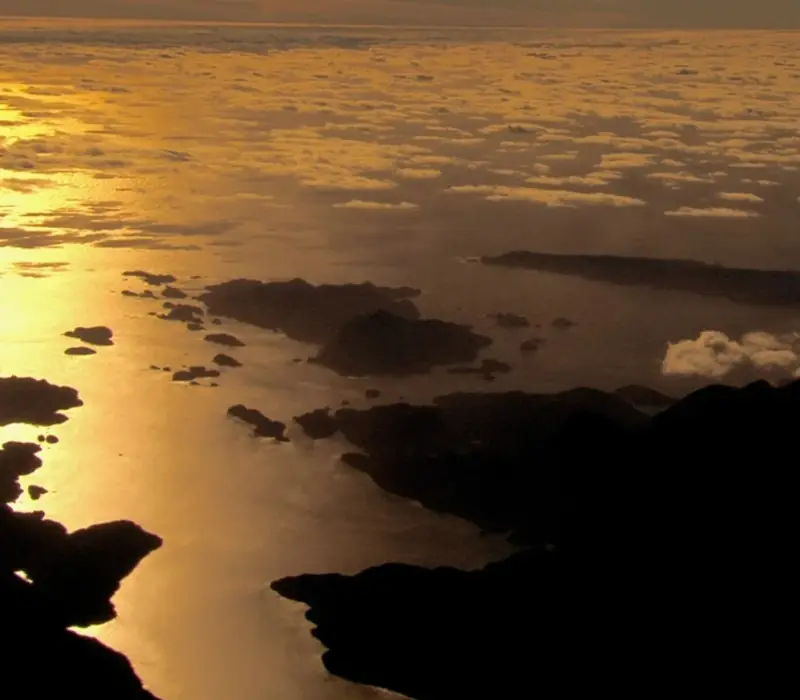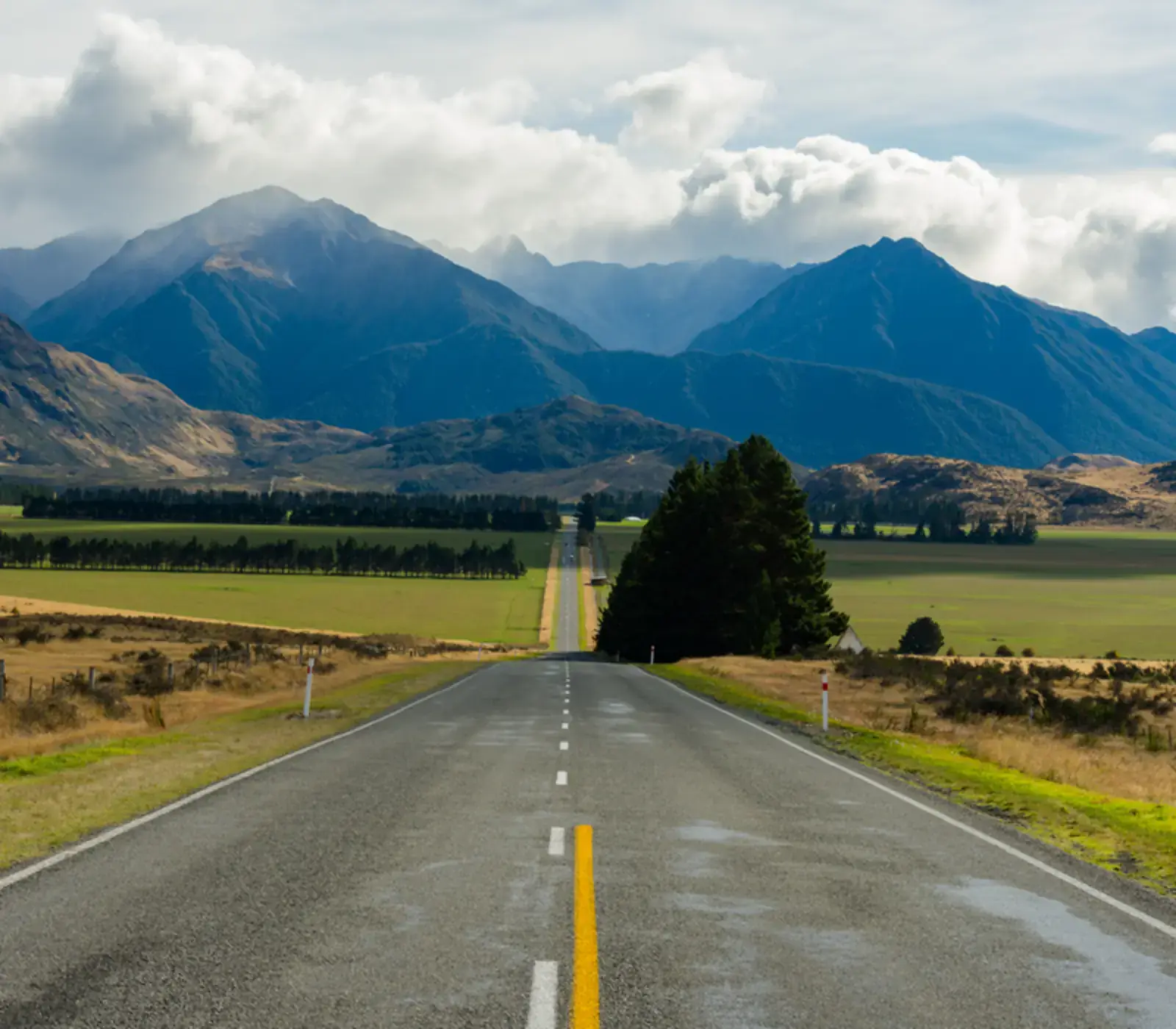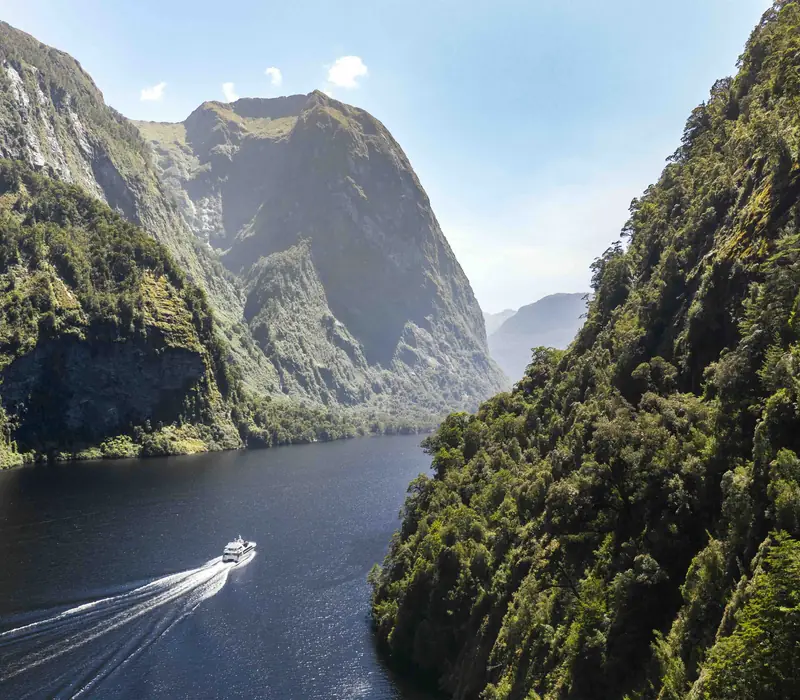
Doubtful Sound, Patea in Māori, is a fiord 40 km long and 421 m deep, the deepest of the fourteen in Fiordland, with three long arms and a scatter of islands between its head at Deep Cove and the Tasman Sea. No public road reaches it. You get there from Manapouri, a village of about 270 people on the shore of Lake Manapouri, 20 minutes south of Te Anau: a boat across the lake, a coach over the Wilmot Pass, then a second boat on the fiord. That journey is half the reason to go, and it is why Doubtful gets a fraction of the visitors Milford does.
Of the itineraries we sell, 26 include Doubtful Sound. 15 of them spend the night on the fiord itself, aboard the Fiordland Navigator, on the 15 overnight cruise; the rest do the day trip, the 5. Most arrive from Te Anau the same morning and carry on to Queenstown afterwards. This page is the Doubtful Sound guide we give people who ask whether it is worth the extra effort.
- From Te Anau (to Manapouri)
- 20 km, about 20 min
- From Queenstown (to Manapouri)
- 172 km, about 2 h 30
- From Invercargill (to Manapouri)
- 157 km, about 2 h 15
- Nearest airports
- Queenstown (ZQN), about 2 h 30 by road to Manapouri, Invercargill (IVC), about 2 h 15 by road
How to get to Doubtful Sound
Every trip starts at Pearl Harbour, the wharf at the southern end of Manapouri township. The first leg crosses Lake Manapouri to West Arm, about 45 minutes on a fast catamaran past wooded islands; the lake is 444 m deep, the second deepest in the country, and has 33 islands. At West Arm you change to a coach for the Wilmot Pass road, 21 km of gravel over a 671 m saddle and down through rainforest to Deep Cove. From the summit, on a clear day, you see down the length of the fiord. At Deep Cove you board the cruise boat.
The road is an oddity. It was built between 1963 and 1965 to haul heavy machinery from ships at Deep Cove for the Manapōuri power station, and it is the only road on the New Zealand mainland not connected to the rest of the road network. You cannot drive a private car onto it; the only vehicles are the ones that came over by barge. The power station itself is 200 m under West Arm, finished in 1971, and it still sends its water out to sea at Deep Cove through two 10 km tunnels. Public tours of the machine hall stopped in 2018 and have not restarted.
| From | Distance | Time | How our tours do it |
|---|---|---|---|
| Te Anau to Manapouri | 20 km | About 20 min | The usual start; 11 itineraries arrive from here |
| Queenstown to Manapouri | 172 km | About 2 h 30 | Coach connections for day cruisers; 5 itineraries come this way |
| Manapouri to Deep Cove | Lake crossing and 21 km road | About 2 h each way | Boat, coach, then the cruise boat |
| Te Anau to Milford Sound | 119 km | About 2 h | The other fiord, for comparison |
From Queenstown the day trip is a marathon: about two and a half hours each way to Manapouri on top of a full day on the water. It can be done by coach, and some people do, but a night in Te Anau or Manapouri beforehand makes it a pleasure rather than an endurance test.
Day cruise or overnight cruise
The day cruise takes most of a day from Manapouri and back. On the fiord the boat runs out towards the Tasman Sea, into one of the arms, and at some point the skipper cuts the engines and asks everyone to stop talking. It is the moment people remember: no road noise, no other boats, just water running off the walls and birds. On a busy summer day you might see two or three other vessels in 40 km of fiord.
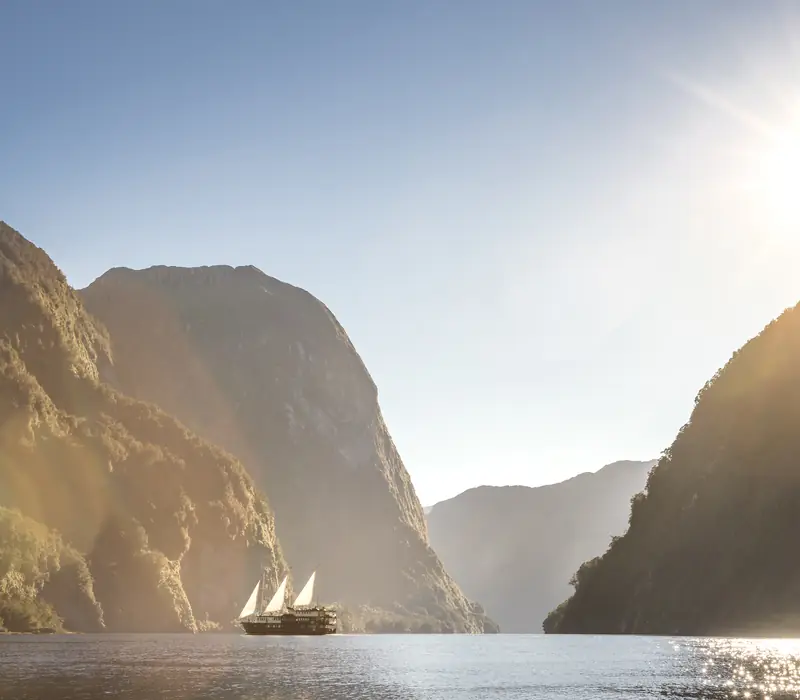
The overnight cruise is the one we recommend if you can take it. The Fiordland Navigator trip leaves Pearl Harbour at half past twelve, sails the length of the fiord, and anchors for the night in a sheltered arm. Before dinner the crew put kayaks and a small tender in the water; after dinner a nature guide gives a talk. You sleep on board in a private cabin with its own bathroom, and wake up inside the fiord with nobody else in sight. 15 of our itineraries include it. You are back at Manapouri at midday, in time to drive to Queenstown. RealNZ, who run it, list it from NZ$749 per person with dinner and breakfast.
Milford Sound or Doubtful Sound?
This is the question we get most, and both answers are right for different people. Milford Sound is compact and vertical: cliffs straight out of the water, Mitre Peak, waterfalls you can almost touch, and a spectacular road in. It is also busy, with coach traffic and scenic flights all day in summer. Doubtful Sound is longer and wider, nearly three times the length of Milford, with arms and islands that make it feel like a drowned mountain range rather than a single canyon. The walls are less sheer, the waterfalls fewer on a dry day, and the silence is the thing.
If you want the famous view and the famous drive, go to Milford. If you want remoteness and time on the water, go to Doubtful. If you can do both, do Milford as a day and Doubtful overnight. Our comparison of the two fiords puts the two side by side.
Wildlife in Doubtful Sound
Doubtful has its own resident pod of bottlenose dolphins, around 70 animals that live in the fiord year round and are studied closely; the boats keep their distance and let the dolphins decide whether to come closer. New Zealand fur seals haul out on the rocks near the entrance, where the fiord meets the open sea. Fiordland crested penguins, tawaki, come ashore to breed in the second half of the year and are sometimes seen near the coast. As in Milford, a layer of dark fresh water sits on top of the salt water, which lets black coral grow at unusually shallow depths. You will not see it from the boat, but it is why divers come here.
Weather and the best time to go
Fiordland is wet. Doubtful Sound gets somewhere between 3 and 6 metres of rain a year depending on where you measure, spread through every season. Rain is not a reason to cancel: the waterfalls only really run after it, and the cloud hanging in the arms is part of the look. Cruises run year round unless the weather is extreme.
Summer, December to February, is the warmest time and the busiest, with the longest days on the overnight boat. Autumn brings cooler mornings and mist in the fiord. Winter, June to August, is often the most settled season, with more clear, still days and snow on the peaks, sometimes down near the water; it is also cold on deck. Spring is the wettest and the waterfalls are at their best. Whatever the month, bring a warm layer and a waterproof jacket, and insect repellent for the sandflies at Deep Cove.
Staying in Manapouri or Te Anau
Manapouri is small: a petrol station, a couple of cafes and a store, two restaurant bars, a hotel, a motel and a motor camp. It is a lovely, quiet place to spend the night before an early boat, with the lake at the end of the street and the Frasers Beach and Circle Track walks from the village. Most people stay in Te Anau, 20 minutes up the road, which has far more beds and restaurants and works as the base for Milford as well. The tours that include the overnight cruise usually put a night in Te Anau on one side of it and drive to Queenstown on the other.
What the itineraries do in Manapouri and Doubtful Sound
26 of our itineraries reach Manapouri and Doubtful Sound and 15 sleep there: 14 for 1 night, 1 for 4 nights. Counted from the day by day of every tour, so the numbers move with the catalogue.
- Doubtful Sound Overnight Cruise, Aboard the Navigator with Real NZ on 15 itineraries
- Doubtful Sound Wilderness Cruise from Manapouri on 5 itineraries
- Ata Whenua - Shadowland Film at Fiordland Cinema on 1 itinerary
- Kepler Track Guided Walk on 1 itinerary
- Pātea-Doubtful Sound on 1 itinerary
- Taxi in Queenstown - Own Arrangements on 1 itinerary
- Te Anau Glowworm Caves with RealNZ on 1 itinerary
- Walking tracks in and around Te Anau on 1 itinerary
Where they stay: Fiordland Navigator Overnight Boat in Doubtful Sound (15), Cabot Lodge (1). Every property is named on its tour page, with the room grade.
Most arrive from Te Anau (11), Queenstown (5) and carry on to Queenstown (8), Te Anau (6), Dunedin (2).