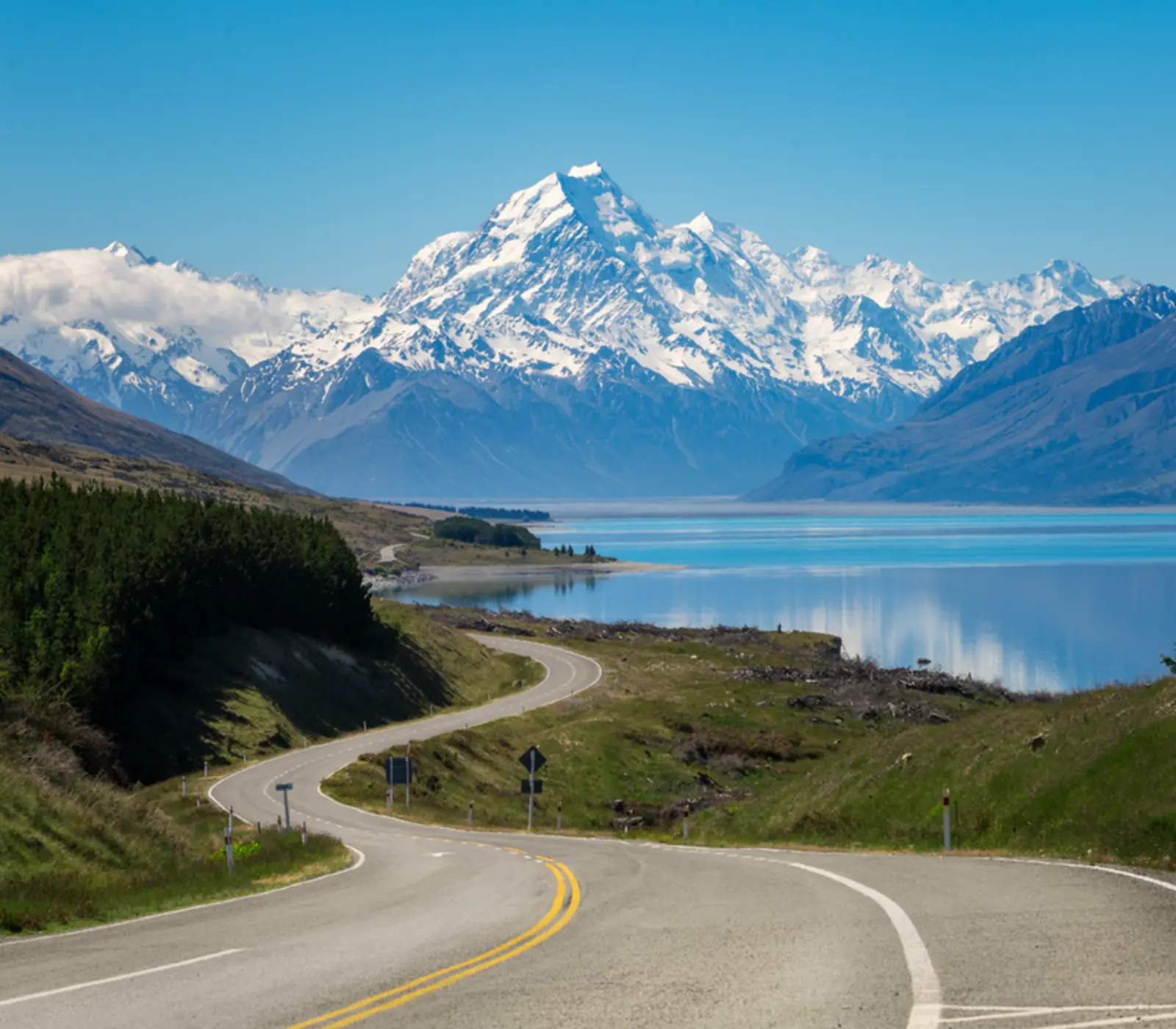
Aoraki / Mount Cook is New Zealand's highest mountain, 3,724 m, and the name of the national park and the small village at its foot. The village sits at 750 m at the end of State Highway 80, a 55 km dead end that runs up the western shore of Lake Pukaki. Nineteen of the country's twenty peaks over 3,000 m are inside the park and glaciers cover 40% of it, yet you can walk to a glacier lake beneath the main peak in three hours on a gravel track. There is a hotel, a few motels and lodges, the DOC visitor centre and not much else, which is a large part of the appeal.
Of the itineraries we sell, 205 reach Aoraki / Mount Cook and 188 sleep in the village: 165 for one night, 23 for two. Most come up from Christchurch by way of Lake Tekapo and carry on to Dunedin or Queenstown. The one thing most of them book is the Glacier Explorers boat among the icebergs on Tasman Lake, on 142 itineraries. Below is what we tell people before they decide whether one night is enough.
- From Christchurch
- 330 km, about 4 h
- From Queenstown
- 265 km, about 3 h 30
- From Lake Tekapo
- 105 km, about 1 h 15
- From Twizel
- 65 km, about 45 min
- Nearest airports
- Timaru (TIU), about 2 h 45 by road, flights from Wellington only, Queenstown (ZQN), about 3 h 30 by road, Christchurch (CHC), about 4 h by road, Aoraki / Mount Cook aerodrome, scenic flights only
Where it is, and what is at the end of the road
The national park covers 707 km² of the Southern Alps in the Mackenzie district of Canterbury. It was created in 1953 and has been part of the Te Wāhipounamu World Heritage Area since 1990. The Haupapa / Tasman Glacier, 23.5 km long, is the longest in the country; the Hooker and Mueller glaciers end in grey meltwater lakes a short walk from the village. The Hermitage hotel has stood here, in one building or another, since 1884, and around it are the DOC visitor centre, a small school and a few hundred residents at most. Twizel, 65 km back down the road, is the nearest town.
Aoraki is the Ngāi Tahu name. In their tradition Aoraki was the eldest son of Raki, the Sky Father. Returning from a visit to Papatūānuku, the Earth Mother, he made a mistake in the karakia for the journey home, the canoe ran aground, and he and his brothers turned to stone as the highest peaks of Kā Tiritiri o te Moana, the Southern Alps. Captain John Lort Stokes named the mountain after James Cook in 1851, and the Ngāi Tahu Claims Settlement Act 1998 made the joint name official. It is also lower than it was. Surveyors in the 1880s put it at 3,764 m; a rock and ice avalanche on 14 December 1991 took 10 m off the summit, and two decades of erosion of the exposed ice cap took another 30 m.
The Hooker Valley Track and the other walks
Most of what there is to do here is free and on foot, and the best of it is the walk everyone does first.
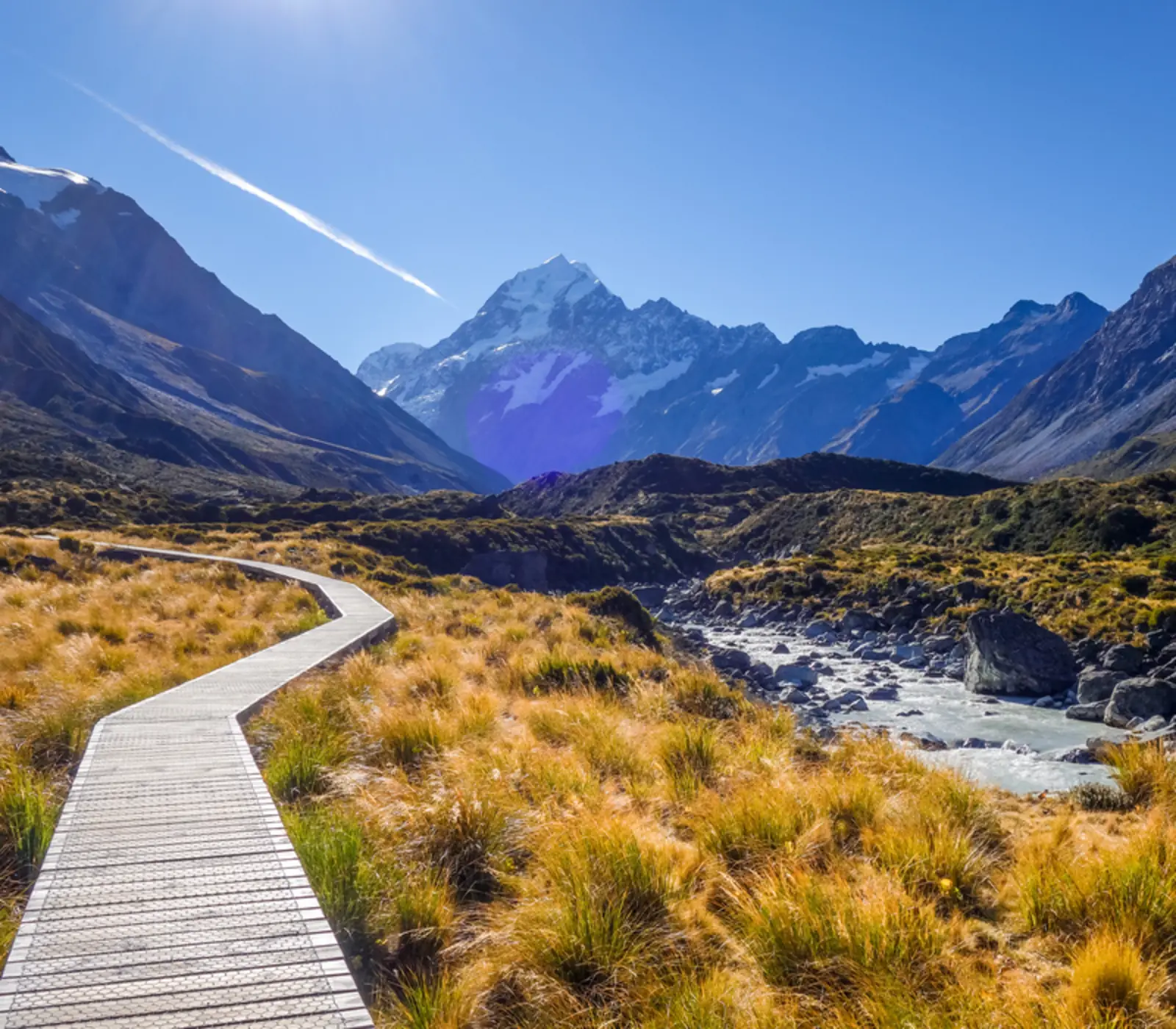
- The Hooker Valley Track: 10 km return, about three hours, from the White Horse Hill car park on a gravel track with some steps to Hooker Lake, where icebergs float in summer below the mountain. There are three swing bridges. The second, 189 m long, opened on 28 July 2026 after the old bridge was closed by riverbank erosion in April 2025, and DOC says it is now the longest suspension bridge in the country. For fifteen months the walk stopped short of the lake; if someone told you it was closed, it is open again.
- Kea Point: an hour return from White Horse Hill, or two from the village, to a viewing deck above the Mueller Glacier lake with Aoraki and Mount Sefton across it. The easiest good view in the park.
- Red Tarns and Sealy Tarns: Red Tarns is 4 km and two hours return to small ponds of red pond weed above the village. Sealy Tarns is 2,200 steps straight up, three to four hours return, and hard on the knees coming down.
- Mueller Hut: 5.2 km and about four hours one way on an advanced route, to a 28-bunk hut that must be booked from November to early May. In winter the route needs an ice axe, crampons and avalanche gear, and DOC warns of snow and ice from March to November.
On 26 of our itineraries the day in the village is left free for these walks. Our guide to Aoraki / Mount Cook has more on timing them.
Tasman Lake, scenic flights and the night sky
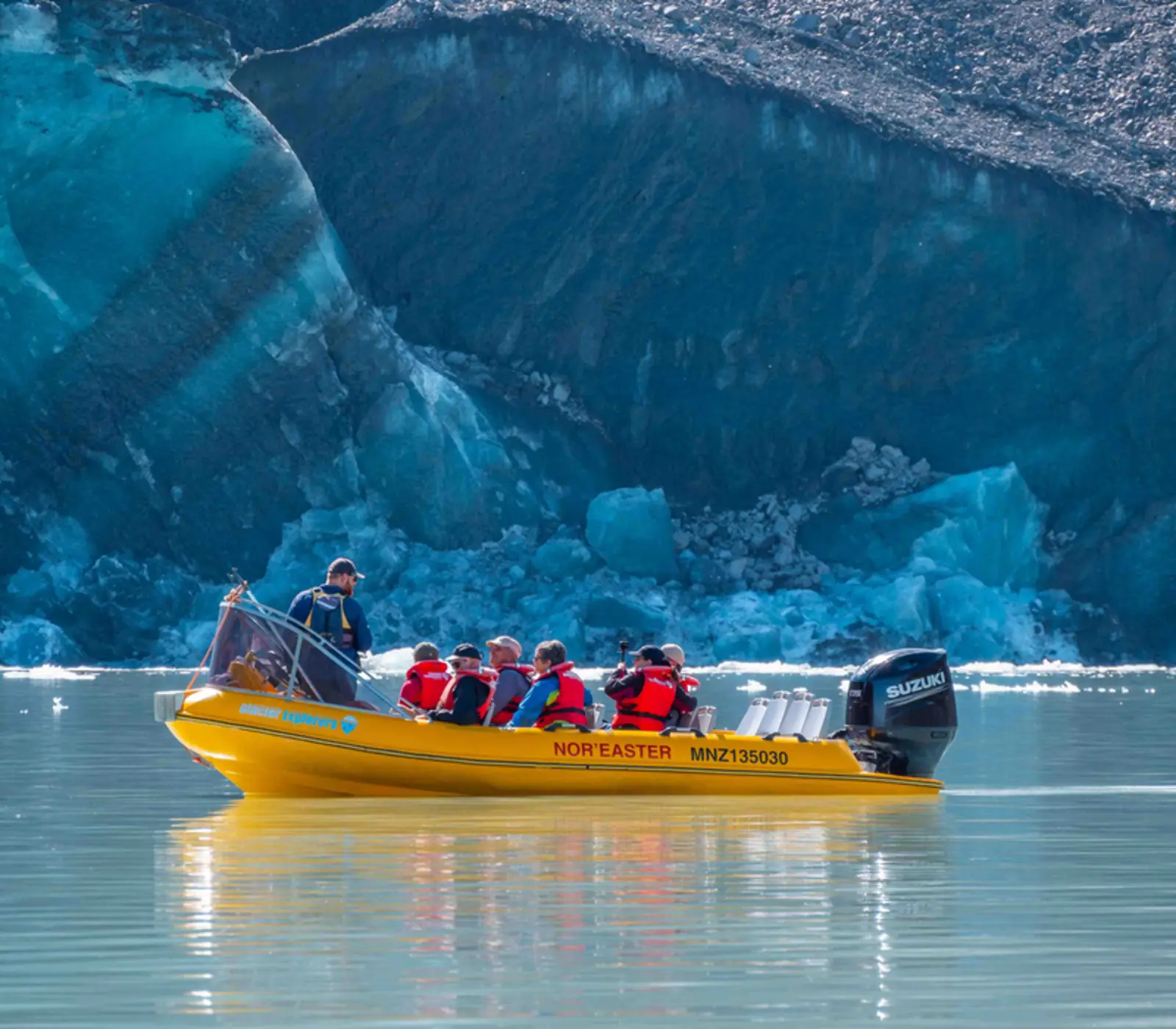
The lake at the foot of the Tasman Glacier did not exist fifty years ago. Meltwater ponds on the glacier's surface in the early 1970s had merged into a single lake by 1990, and it keeps growing as the ice retreats. Glacier Explorers runs boats among the icebergs from 1 September to mid-June: you walk 1.5 km, about 25 minutes, from the car park to the jetty, spend an hour on the water, and the whole trip from the Hermitage takes about two and three quarter hours. It is on 142 of our itineraries. If you would rather not pay, the Tasman Glacier View walk, 1.5 km and 30 minutes return, shows you the lake and the ice from the moraine wall above.
Harry Wigley landed a ski plane on the Tasman Glacier on 22 September 1955, reputedly the first landing of its kind in the southern hemisphere, and ski planes still fly from the aerodrome 5 km south-east of the village. Helicopters fly from Glentanner, 15 minutes down the lake. A scenic flight with a glacier landing is on 9 of our itineraries, a longer helicopter flight across to the West Coast glaciers on 5, and a guided heli hike on the Tasman Glacier on 4.
At night, the park and the Mackenzie Basin around it make up the Aoraki Mackenzie International Dark Sky Reserve, 4,367 km², designated in 2012. 10 of our itineraries include Big Sky Stargazing, which moves indoors to a full-dome planetarium when the cloud is down. The Sir Edmund Hillary Alpine Centre at the Hermitage covers the climbing history of the mountain and is where to spend a wet afternoon; our stargazing guide compares the dark sky sites.
How to get to Aoraki / Mount Cook
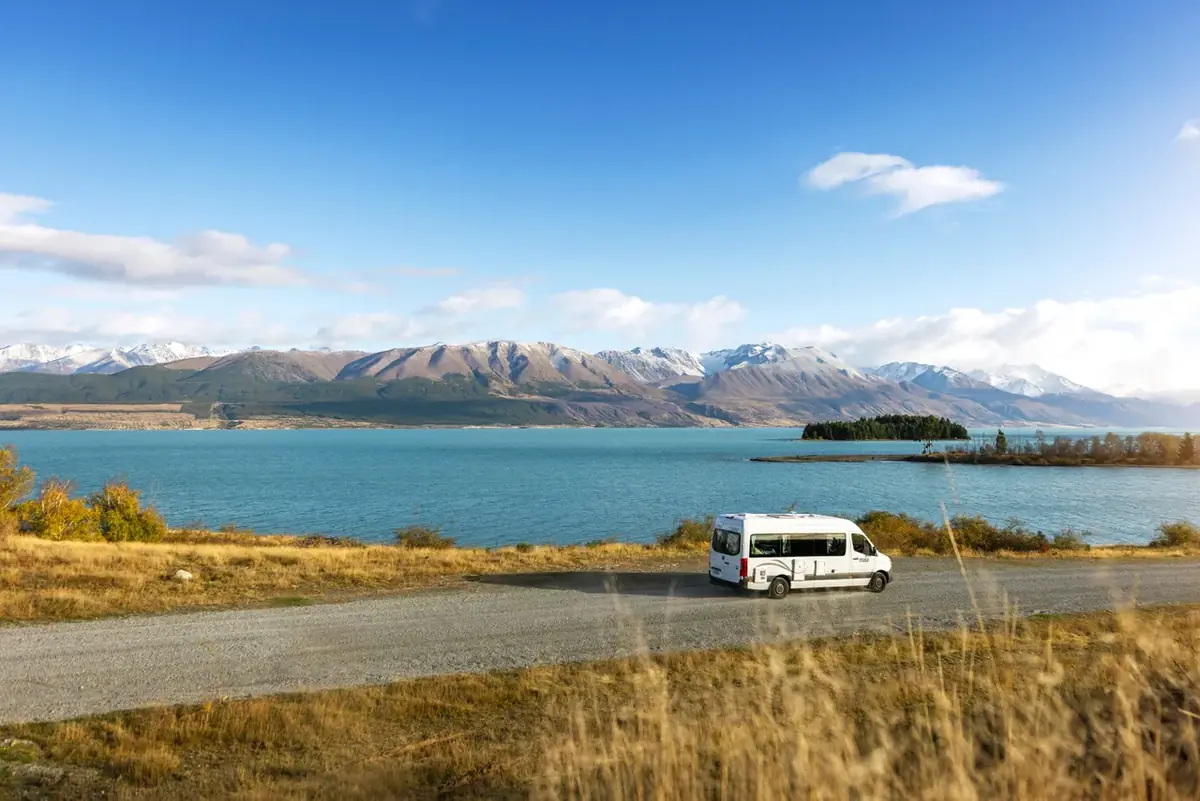
There is one road in, and it is also the road out. State Highway 80 leaves State Highway 8 at the southern end of Lake Pukaki and runs 55 km up the lake's western shore to the village, mostly two lanes with a few one-lane bridges. On a clear day the mountain sits at the end of the road the whole way. From Christchurch it is about four hours via Geraldine and Lake Tekapo; from Queenstown about three and a half over the Lindis Pass, at 971 m the highest point on the South Island's state highways.
| From | Distance | Driving time | How our tours do it |
|---|---|---|---|
| Christchurch | 330 km | About 4 h, via Lake Tekapo | 129 itineraries arrive this way |
| Queenstown | About 265 km | About 3 h 30, over the Lindis Pass | 26 arrive from here and 61 carry on to it |
| Dunedin | About 330 km | About 4 h, via Oamaru and the Waitaki valley | 65 itineraries carry on to Dunedin |
| Lake Tekapo | 105 km | About 1 h 15 | On the road from Christchurch |
| Twizel | 65 km | About 45 min | The nearest town, and the overflow when the village is full |
The nearest airports with scheduled flights are Timaru, which has Air New Zealand flights from Wellington only, then Queenstown and Christchurch; the Mount Cook aerodrome is for scenic flights. In winter, and on autumn and spring mornings, the roads through the Mackenzie ice up, and the Lindis Pass and Burkes Pass see snow. Carry chains between May and September and check the NZTA journey planner the morning you drive.
One night or two, and Tekapo or the village
Most of our itineraries give the village one night, and in settled weather that is enough: arrive in the early afternoon, take the boat or walk up to the Tasman Glacier View, eat at the Hermitage, walk the Hooker Valley at dawn and leave after breakfast. The risk is the weather. If cloud sits on the peak the evening you arrive and the morning you leave, you will have driven a long way to see the lower half of a mountain, and a flight cancelled for wind has no second chance. If Aoraki is one of the reasons you are going to New Zealand, give it two nights, as 23 of our itineraries do.
Lake Tekapo or Mount Cook? They are 105 km apart and do different jobs. Lake Tekapo is a lakeside town with more beds and restaurants, the Church of the Good Shepherd and the observatory on Mount John. The village has the walks and the mountain. If you can sleep in only one, we would sleep here and see Tekapo on the way through. Twizel, 45 minutes away, has more beds than the village and is a workable base when the village is full, at the cost of the dawn walk.
Where to stay in Mount Cook Village
The Hermitage has been the village hotel since 1884, though not in the same building. The first was damaged in 1913 when a stream broke through from the Mueller Glacier, its replacement opened in 1914 and burned down in 1957, and the present hotel opened in 1958. Our itineraries book it at several room grades, among them the Aoraki Wing premium rooms (41), rooms with a view of the mountain (23) and the Wakefield Wing (16). If the view matters to you, check the grade on the tour page; every property is named there with its room type. Two of the hotel's restaurants turn up in our itineraries: dinner in the Panorama Room on 14 and the buffet in the Alpine Restaurant on 7.
The Mt Cook Motel's self-contained units take 74 of our itineraries, and a few use the Aoraki Court Motel. Beyond those there are a lodge or two, DOC's White Horse Hill campground at the start of the Hooker Valley Track, and a holiday park at Glentanner, 15 minutes down the lake. Book early for December to March: the village has few beds, and the next ones down the road are at Glentanner and Twizel.
Weather and the best time to go
The village records about 4,100 mm of rain a year on around 156 days, and the mean temperature runs from 14.6 °C in January to 2.5 °C in July. It comes in bursts as fronts cross the Alps from the west, and the days between them are often clear. The MetService forecast for Mount Cook is the one to check, a day or two out rather than a week.
- Summer, December to February: long days and the most visitors. The Mount Cook lily, which is the largest buttercup in the world rather than a lily, flowers from late spring into early summer.
- Autumn, March to May: often the most settled weather, cold clear mornings and the first snow on the tops. Our pick.
- Winter, June to August: snow to the valley floor on some days and the darkest skies of the year. The Hooker Valley stays open but can be icy, and DOC advises microspikes and poles; the Glacier Explorers boats stop for July and August.
- Spring, September to November: the boats restart on 1 September, the snow draws back up the valleys, and the lilies start towards the end of the season.
Climbing Aoraki: what it takes
Aoraki was first climbed on Christmas Day 1894 by Tom Fyfe, Jack Clarke and George Graham. Edmund Hillary made his first ascent in January 1948 and a month later made the first ascent of the South Ridge, renamed Hillary Ridge in 2011. The mountain looks modest next to the Himalaya, but the standard route from Plateau Hut crosses the crevasses of the Linda Glacier, exposed to ice and rock fall, and summit day is 15 to 18 hours of steady climbing with 1,700 m of height gain. Around 80 people have died attempting it since the early 20th century, more than on any other New Zealand peak. Alpine Guides, in the village since 1966, guides it one to one, and only for clients who have already climbed its prerequisite peaks. For everyone else, the Hooker Valley and Mueller Hut are as close as you need to get.
What the itineraries do in Aoraki / Mount Cook
205 of our itineraries reach Aoraki / Mount Cook and 188 sleep there: 165 for 1 night, 23 for 2 nights. Counted from the day by day of every tour, so the numbers move with the catalogue.
- Glacier Explorers on 142 itineraries
- Aoraki / Mt Cook National Park on 53 itineraries
- Walking Tracks in Aoraki-Mt Cook National Park on 26 itineraries
- The Panorama Room 3-course Dinner with The Hermitage Hotel on 14 itineraries
- Aoraki-Mount Cook to Queenstown Small Group Tour with Cheeky Kiwi on 13 itineraries
- Big Sky Stargazing on 10 itineraries
- Glacier Highlights - Scenic Flight with Glacier Landing on 9 itineraries
- The Alpine Restaurant Buffet Dinner on 7 itineraries
Where they stay: Mt Cook Motel (74), Hermitage Hotel, Aoraki Wing Premium (41), Hermitage Hotel Room Mount Cook View (23), Hermitage Hotel, Wakefield Wing Superior Room (16), Hermitage Hotel, Aoraki Wing Premium Plus (13), Aoraki Court Motel (2). Every property is named on its tour page, with the room grade.
Most arrive from Christchurch (129), Queenstown (26), Dunedin (17) and carry on to Dunedin (65), Queenstown (61), Christchurch (43).