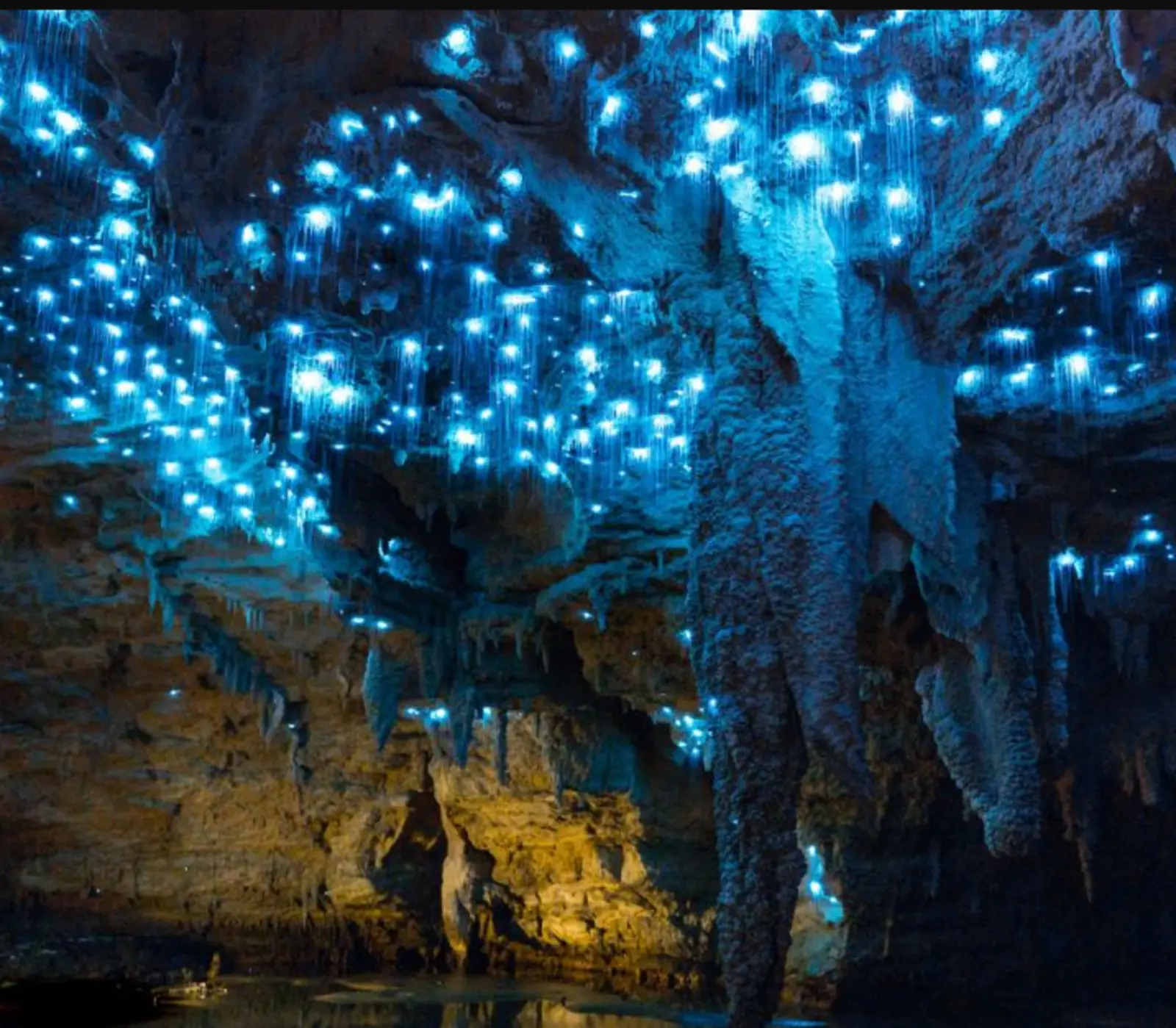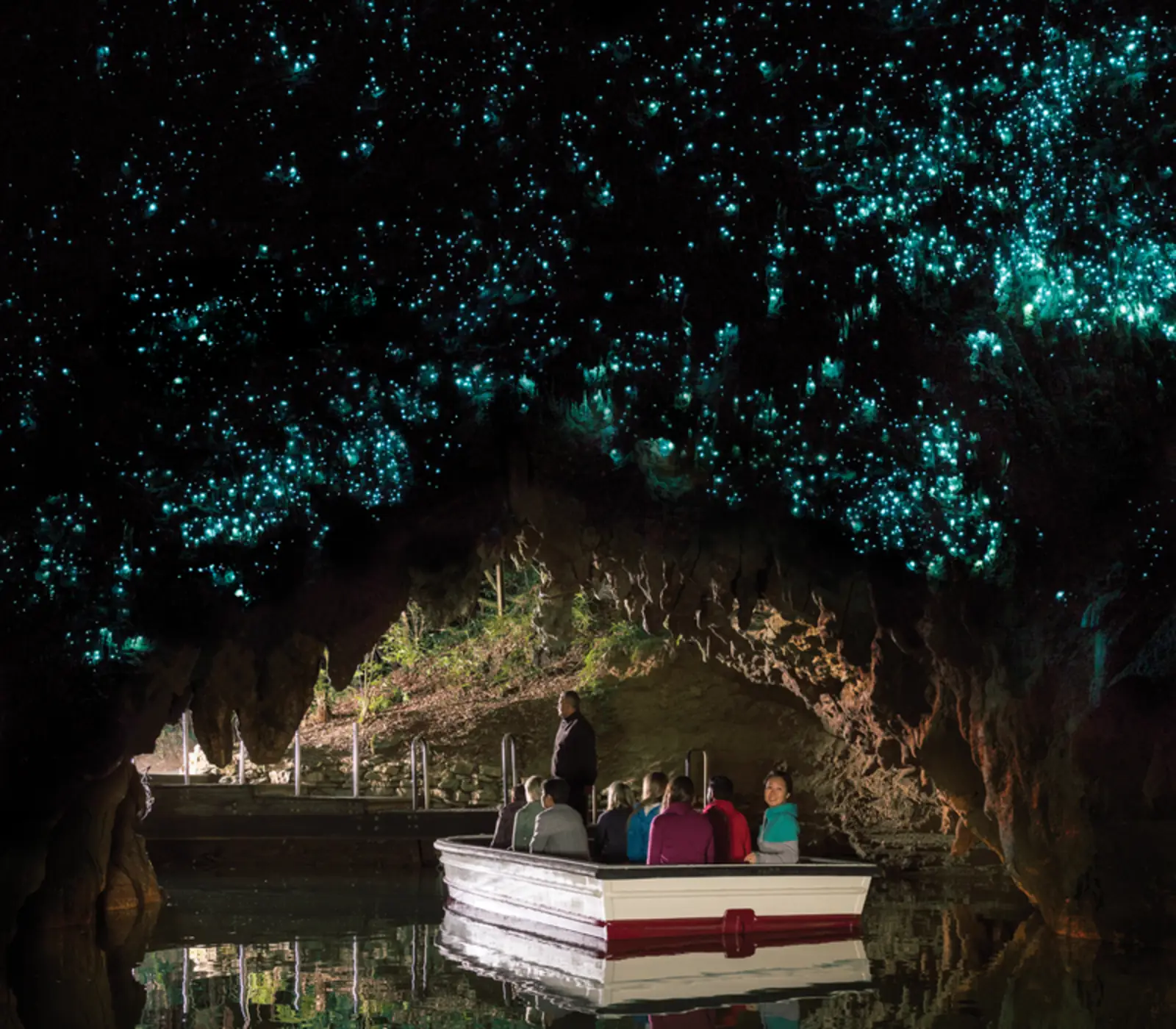
Waitomo is a small village in the green limestone hill country of the King Country, about 190 km south of Auckland, sitting on top of more than 300 known caves, sinkholes and underground rivers. The name joins the Māori words wai, water, and tomo, a hole or shaft, which is exactly what the landscape is. The famous one is the Waitomo Glowworm Cave, where a boat drifts in silence through a grotto whose ceiling is lit by thousands of glowworms. There are two other show caves, Ruakuri and Aranui, and a whole industry of underground rafting and abseiling for people who want to get wet.
Of the itineraries we sell, 65 stop at Waitomo, usually on the day between Auckland and Rotorua or on the way south to the Tongariro volcanoes. Most visit for a few hours: 23 stay the night, nearly all of them for one night (19). They arrive from Auckland (9) or Rotorua (8), and the caves they book are the Glowworm Cave with Aranui (5 itineraries), the Discover Waitomo glowworm tour (5) and the private Footwhistle cave with CaveWorld (4).
- From Auckland
- 190 km, about 2 h 40
- From Hamilton
- 75 km, about 1 h
- From Rotorua
- 150 km, about 2 h
- Nearest airports
- Hamilton (HLZ), 75 km, Rotorua (ROT), 150 km, Auckland (AKL), 190 km
The Waitomo Glowworm Cave and how it was found
The cave was explored in December 1887 by Tane Tinorau, a local Māori chief, and Fred Mace, an English surveyor, who went in by raft where the Waitomo Stream disappears underground. By 1889 Tinorau and his wife Huti were taking paying visitors through. The government took the cave over in 1905, and in 1989 the land and cave were returned to the original owners, many of them descendants of Tinorau and Huti, who now share in the revenue, and some of the guides are family.
The tour takes about 45 minutes. You walk through the upper level, including the Cathedral, a chamber about 13 m high with good acoustics, then down to the river, where a boat takes you through the Glowworm Grotto in the dark. Photography is not allowed inside, and you are asked to stay quiet, both to protect the glowworms and so that the next group gets the same silence you did. It is busy at midday in summer: about half a million people a year come through.
Which Waitomo cave is worth it?
The operator, Discover Waitomo, runs the three show caves. At the time of writing, adult prices start at NZ$81 for the Glowworm Cave or Aranui and NZ$116 for Ruakuri, with combination tickets for two or three caves. Check the operator's site for current prices and times.
- Waitomo Glowworm Cave, about 45 minutes: the boat ride through the grotto. The one to do if you do only one, and the shortest.
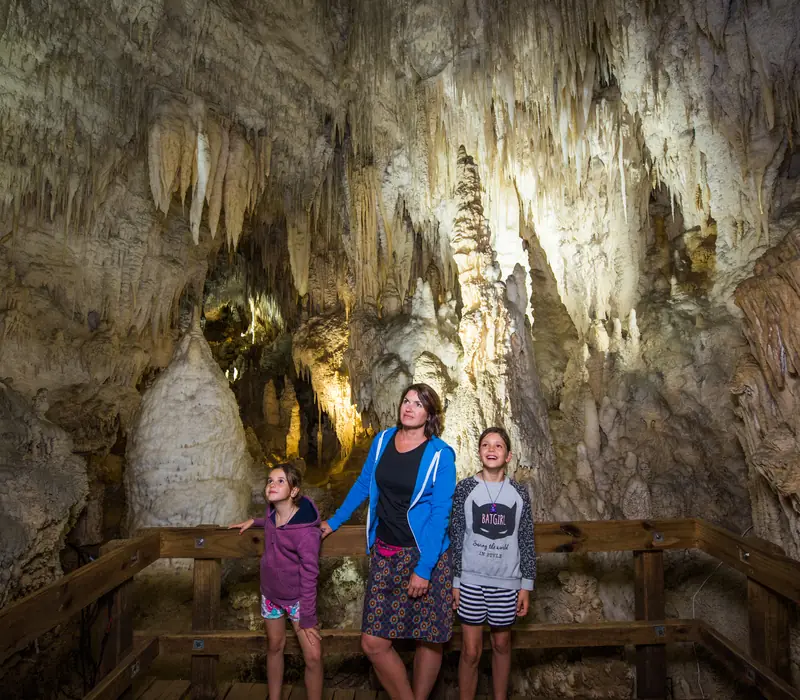
- Ruakuri Cave, about 1.5 hours: entered down a spiral ramp built into an old shaft, then along walkways beside an underground river, with glowworms and limestone formations. Longer, less crowded and more varied than the Glowworm Cave. The operator describes it as wheelchair accessible.
- Aranui Cave, about 1 hour: a dry cave with no glowworms but fine pink and white stalactites and straws. For people who like geology; the least essential of the three.
- Black water rafting and caving: the Legendary Black Water Rafting Company runs the Black Labyrinth, about 3 hours floating on inner tubes down an underground river, and the Black Abyss, about 5 hours with an abseil and a flying fox. Waitomo Adventures runs the Lost World, an abseil down a deep vertical shaft, which is on 2 of our itineraries.
Our advice: the Glowworm Cave if you are passing through and short of time; Ruakuri if you have two hours and want a better cave; black water rafting if you are over the age limit and do not mind cold water. Our guide Waitomo: which cave is actually worth it? goes through the choice in more detail.
Glowworms: what you are actually looking at
The glowworm, titiwai, Arachnocampa luminosa, is not a worm. It is the larva of a fungus gnat found only in New Zealand. The larva lives on the cave ceiling and lets down dozens of silk threads beaded with sticky droplets, then glows blue-green to draw in midges and other insects, which catch in the threads and get reeled up and eaten. The adults do not eat at all and live only a few days.
Why no touching, no photos and no noise? The larvae dim their lights when disturbed, and the whole colony depends on the cave staying damp and still. In 1979 the Glowworm Cave had to close for a time after a new entrance door changed the airflow and dried the cave out. Glowworms are not rare in New Zealand; you find them on damp banks in bush all over the country. What is rare is a grotto like this, where thousands of them light a ceiling above still water.
How to get to Waitomo
Waitomo is 8 km west of State Highway 3, south of Ōtorohanga. From Auckland you go down State Highway 1 to Hamilton and then State Highway 3 south. From Rotorua it is two hours across the Waikato, which makes Waitomo and Hobbiton an awkward pair on one day unless you start early. There is no scheduled public transport to the village itself, so most visitors drive or come on a day tour.
| From | Distance | Driving time | Notes |
|---|---|---|---|
| Auckland | About 190 km | About 2 h 40 | Day tours from Auckland run most days |
| Hamilton | About 75 km | About 1 h | The nearest city and airport |
| Rotorua | About 150 km | About 2 h | The usual next stop |
| Ōtorohanga | About 16 km | About 15 min | The nearest town, with a supermarket and the Kiwi House |
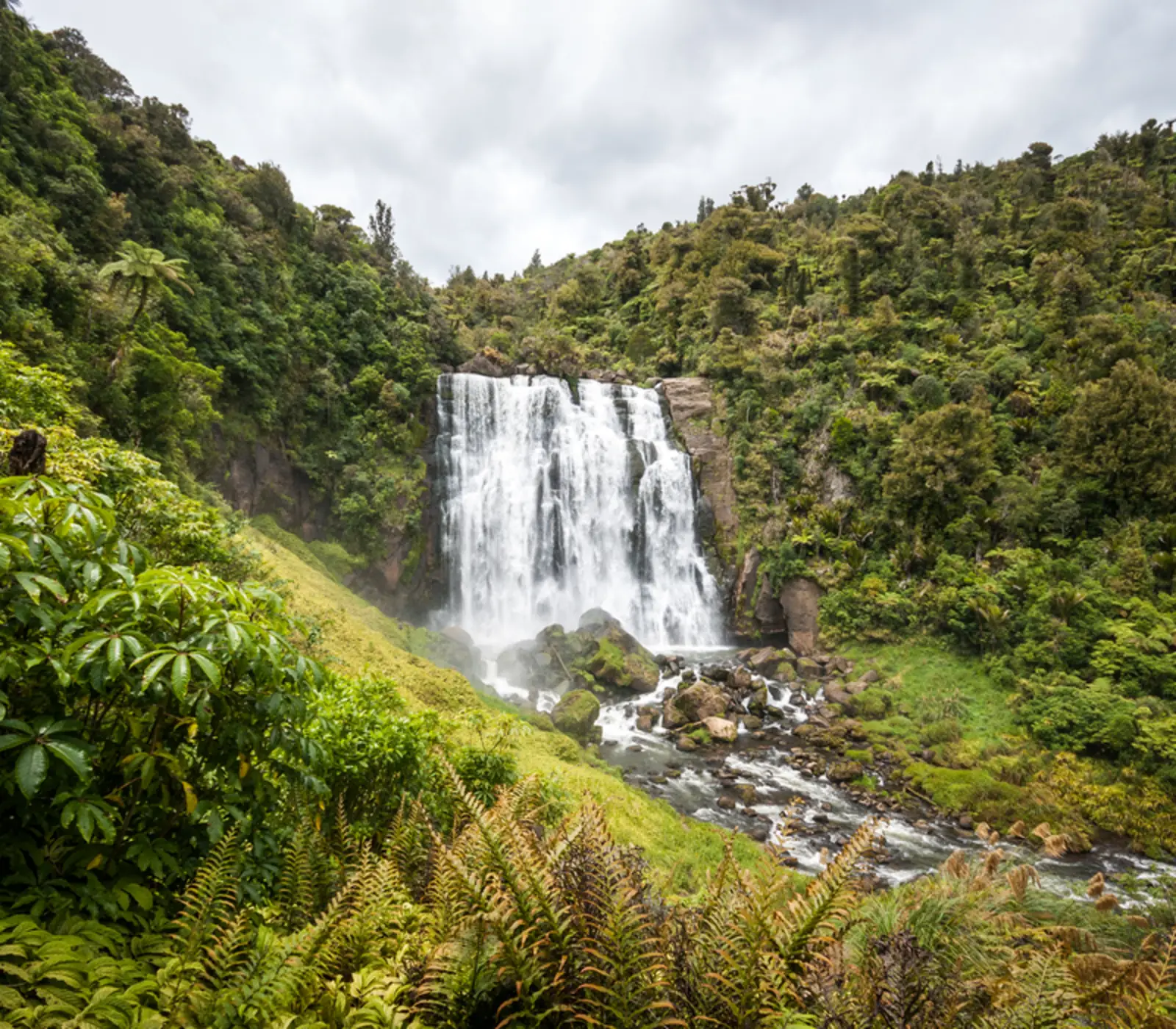
The nearest airports with scheduled flights are Hamilton (HLZ) and Rotorua (ROT), but nearly everyone arrives by road from Auckland. If you are driving on west afterwards, the road to the coast passes the Mangapōhue Natural Bridge and Marokopa Falls, two of the best short walks in the region.
Day trip or overnight, and when to go
A day trip is enough to see one or two caves, and that is how most of our itineraries do it. Staying the night buys you the Ruakuri Walk after dark, the caves early in the morning before the Auckland coaches arrive, and time for black water rafting without a long drive afterwards. Two nights only makes sense for serious cavers.
The caves stay at roughly 12 to 14°C all year, so the season hardly matters underground; bring a light jacket in summer and good shoes in any month. Above ground the King Country is green because it rains a lot. December to March is busiest, with New Zealand school holidays in January; the first tours of the morning and the last of the afternoon are quieter. Heavy rain can occasionally close the Glowworm Cave boat ride when the river rises, so a spare hour in your plan helps.
Where to stay near Waitomo
The village is tiny: a cafe or two, a pub, a holiday park and a handful of lodges and B&Bs, several of them on farms nearby. Ōtorohanga, 15 minutes away, has more motels. The properties our itineraries use:
- Palm Court Motel, Ōtorohanga (6 itineraries): a motel in town, practical and close to the highway.
- Waitomo Caves Guest Lodge (5): a small lodge in the village, walking distance to the caves.
- Abseil Inn (4): a B&B on the hill above the village.
You can see every trip that stops at the caves on the tours through Waitomo, from NZ$1,740. If you are heading on east, our Rotorua page covers the next stop.
What the itineraries do in Waitomo Caves
65 of our itineraries reach Waitomo Caves and 23 sleep there: 19 for 1 night, 4 for 2 nights. Counted from the day by day of every tour, so the numbers move with the catalogue.
- Glow Worm Caves Tour with Discover Waitomo on 5 itineraries
- Waitomo Glowworm Caves and Aranui Cave tour on 5 itineraries
- Private Footwhistle Glowworm Cave Tour with CaveWorld on 4 itineraries
- Waitomo on 4 itineraries
- After viewing the city sights, set your GPS for the Waitomo Caves on 2 itineraries
- Hobbiton Movie Set Signature Tour from Shires Rest on 2 itineraries
- Lost World Caving Tour with Waitomo Adventures on 2 itineraries
- The Waitomo Caves are radiant, quite literally on 2 itineraries
Where they stay: Palm Court Motel Otorohanga (6), Waitomo Caves Guest Lodge (5), Abseil Inn (4), Kohutapu Lodge (1), Waitomo Lodge Motel (1), Wild Canvas - Kowhai Tent (1). Every property is named on its tour page, with the room grade.
Most arrive from Auckland (9), Rotorua (8), Whakapapa (2) and carry on to Auckland (10), Rotorua (5), Tongariro (4).